
Introduction
The digital landscape is transforming at lightning speed. Traditional SEO — once centered around keywords, backlinks, and on-page optimization — is no longer enough.
The emergence of AI-driven search through platforms like ChatGPT, Google Gemini, and Perplexity has reshaped how users discover and trust information online.
These tools don’t just show results — they generate answers. And the way they understand, interpret, and recommend content has completely changed the SEO playbook.
Welcome to the era of AI Search Optimization (AISO) — the future of visibility, authority, and digital relevance.
1. What Is AI Search Optimization?
AI Search Optimization (AISO) means fine-tuning your digital content so that AI-driven search engines like ChatGPT, Gemini, and Bing Copilot can interpret, learn from, and recommend it in generated responses.
Unlike traditional SEO, which depends on indexing and ranking, AISO focuses on:
- Semantic meaning (not just keywords)
- Contextual understanding
- Machine readability and data structure
- Trust signals and accuracy
AI Search Optimization ensures that when someone asks “Which company provides the best SEO Services in India?”, your brand stands a chance of being referenced by AI search systems — not just listed on Google.
2. The Rise of AI Search: ChatGPT, Gemini & Beyond
AI search platforms are redefining how people interact with the web:
- ChatGPT (OpenAI): Provides human-like conversational responses, summarizing verified data into clear insights.
- Google Gemini: Combines deep learning with Google’s index for real-time, multimodal answers.
- Perplexity.ai: Prioritizes transparency by citing sources within responses.
- Bing Copilot: Integrates ChatGPT’s reasoning with live web data for contextual accuracy.
Each of these uses Large Language Models (LLMs), which learn context, meaning, and relationships — not just keywords. That’s why your website must be optimized for understanding, not just ranking.
3. Why Traditional SEO Alone Won’t Be Enough
Search algorithms are evolving from keyword-matching to intent interpretation.
Traditional SEO can still drive results, but it’s no longer the end goal — it’s just the foundation.
AI systems now prioritize:
- Expertise and authority
- Content depth and context
- Consistent factual data
- Machine-friendly structure (schema + clean code)
In short, AI doesn’t care about keyword count — it cares about content intelligence.
4. How AI Search Understands and Selects Content
AI platforms analyze contextual meaning, not just text. They map your brand and content to relevant entities and compare accuracy across sources.
They prioritize:
- Entity mapping: Understanding who you are and what you offer.
- Fact verification: Matching your claims with trustworthy sources.
- Intent alignment: Ensuring your content satisfies what the user meant, not just what they typed.
To succeed, your content must be contextually rich, factually consistent, and technically structured.
5. The Role of Structured Data in AI Search
Structured data (schema) is the secret language between your website and AI search tools.
By using JSON-LD schemas, you help AI systems clearly identify:
- Your organization
- Services offered
- Reviews and testimonials
- FAQs
- Locations
This clarity improves how AI tools like Gemini or Perplexity interpret your website and decide whether to reference it.
6. Optimizing for Conversational Queries
People no longer search with keywords like “best SEO company near me.”
They ask questions like:
“Which SEO services can help small businesses grow online?”
To match this shift:
- Write natural, question-based headings.
- Use long-tail, conversational keywords.
- Include FAQs and dialogue-style phrases like “Here’s how” or “Let’s explore.”
This conversational tone makes your content not only user-friendly but also AI-trainable.
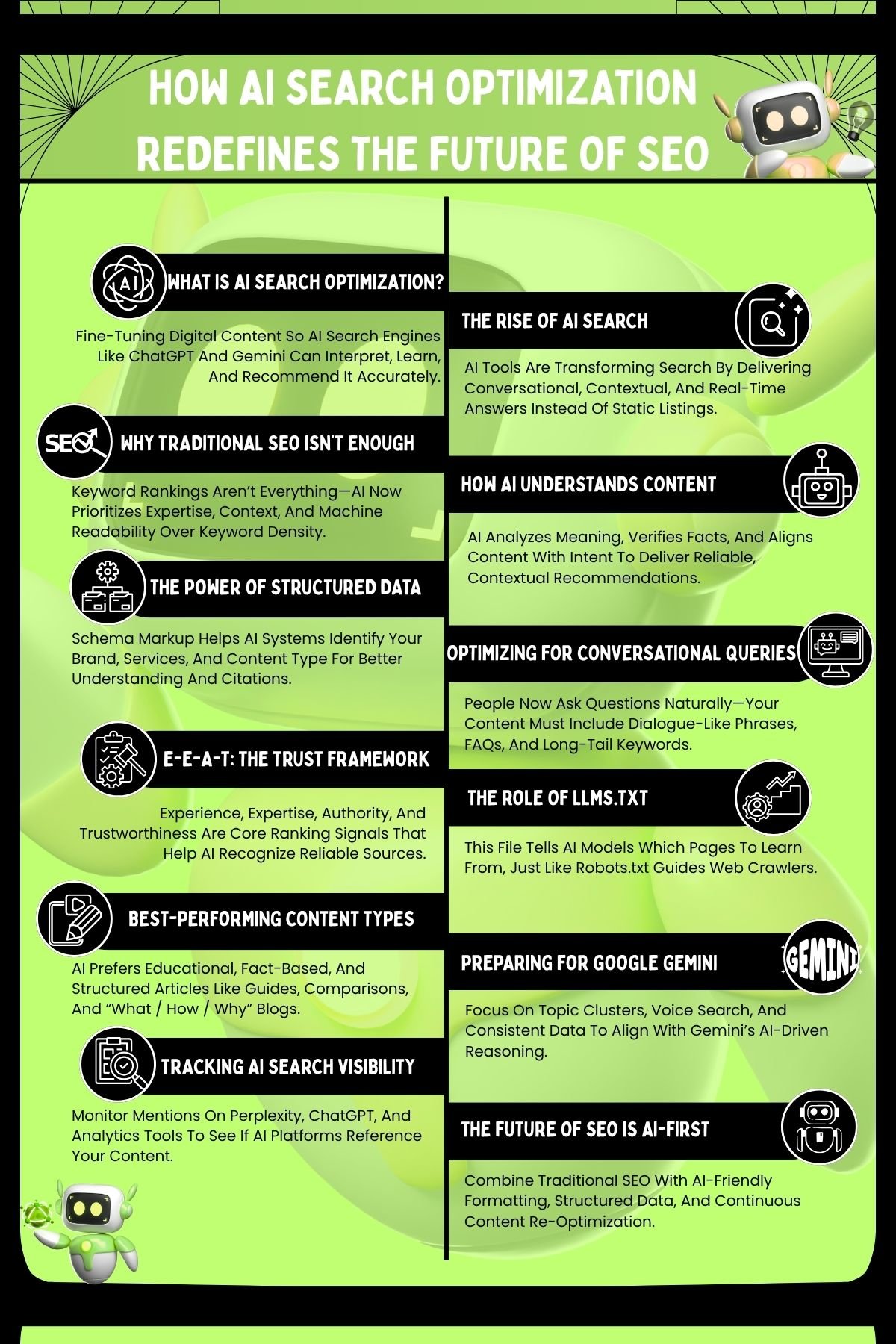
7. E-E-A-T: The Foundation of AI Search Visibility
AI systems reference trustworthy content written by real experts.
That’s why Google’s E-E-A-T (Experience, Expertise, Authoritativeness, Trustworthiness) framework has become the gold standard.
To build E-E-A-T:
- Publish authored content with real credentials.
- Include about-author sections and professional bios.
- Provide original data or client insights.
- Maintain factual accuracy and consistency across channels.
Your goal is to make AI systems recognize your brand as an expert source, not just another website.
8. The Role of LLMS.txt in AI Search Optimization
Just as robots.txt guides Google crawlers, LLMS.txt guides AI models on which pages to read or exclude for learning.
For example:
Allow: /services/seo-services/
Disallow: /private/
Adding this file helps AI tools like ChatGPT or Gemini understand what parts of your website to analyze — especially your key service pages and blog content.
9. Content That Performs Best in AI Search
AI-powered systems prioritize content that’s:
- Educational – explains topics clearly
- Authoritative – cites or aligns with credible data
- Readable – written in natural, human tone
- Well-structured – organized with H2s, lists, and tables
Formats that perform best:
- Long-form blogs
- “What / How / Why” articles
- Comparison guides (e.g., “SEO vs Paid Ads”)
- In-depth FAQs
10. Preparing for Google Gemini and 2026 SEO Trends
As we move into 2026, Google Gemini is expected to fully integrate AI-driven reasoning into search results.
Here’s how to prepare:
- Combine SEO and AI Optimization in one workflow.
- Focus on topic clusters rather than isolated pages.
- Optimize for visual, voice, and contextual search.
- Keep data consistent across your website, GMB, and social media.
Gemini’s goal is not just to rank — but to understand. Your goal is to make your brand the one it trusts to cite.
11. How to Track AI Search Visibility
Even though AI platforms don’t provide analytics dashboards yet, you can track indirect metrics:
- Check Perplexity.ai for citations of your site.
- Monitor ChatGPT or Quora mentions using brand tracking tools.
- Use semantic analytics tools like AlsoAsked or Keyword Insights.
- Analyze AI-based referral traffic in GA4 and server logs.
These signals help you understand whether your content is being “read” and used by AI tools.
12. Integrating AI Optimization into Your SEO Strategy
AI optimization doesn’t replace SEO — it enhances it.
A modern SEO strategy in 2026 should combine:
- Technical and On-Page SEO
- Structured Data Implementation
- AI-friendly content formatting
- Ongoing analytics and content re-optimization
This fusion ensures your brand appears not just on Google, but inside AI-generated results across platforms.
13. Why Businesses Must Adapt Now
Adopting AI Search Optimization early means getting a head start on tomorrow’s visibility.
Businesses that delay will struggle to appear in AI-generated responses later.
The future belongs to brands that:
- Produce human-like, factual, structured content
- Implement schema and LLMS.txt files
- Build authority and trust through transparency
This isn’t a prediction — it’s a transition already in motion.
Conclusion
AI search is redefining how brands are discovered and trusted online. Optimizing for ChatGPT, Gemini, and other AI-driven tools isn’t just a trend — it’s the next evolution of SEO.
As we move deeper into 2026, businesses that combine traditional optimization with AI Search Optimization will dominate visibility across both Google and AI ecosystems.
At Hunky Dory Solutions (HDS), our expert team delivers future-ready SEO Services that ensure your brand remains visible, credible, and discoverable across every platform.
As a forward-thinking Creative Brand Marketing Company, we integrate AI-driven SEO, advanced analytics, and strategic content architecture to future-proof your online presence — making sure your business stays ahead of every algorithm change.